
 Azerbaijan
 Kazakhstan
 Kyrgyzstan
 Turkmenistan
 Northern Cyprus
 Türkiye
 Tatarstan
 Bashkortostan
 Sakha (Yakutia)
 Gagauzia
 North Macedonia
 Bulgaria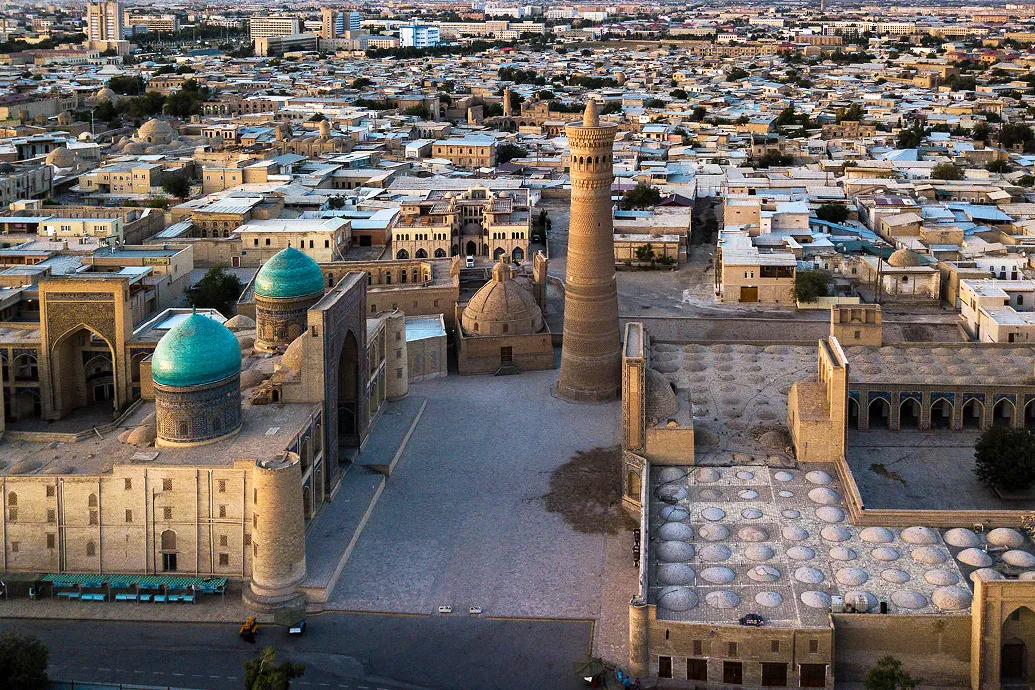
Po-i-Kalyan
In the heart of Bukhara, a minaret, a mosque and a madrasah face each other across one courtyard, forming the city's most recognisable scene. With its nine-century-old minaret and blue-domed mosque, it is one of the easiest places to take in Central Asian architecture in a single square.
History
The name Po-i-Kalyan (also Poi Kalon) is Persian and roughly means "At the Foot of the Great One", the great one being the Kalan Minaret. The site is said to have held a Zoroastrian place of worship before Islam, and after 713 a succession of congregational mosques was built, destroyed and restored south of the Ark.
The Karakhanid ruler Arslan Khan had a mosque completed in 1121 and its minaret in 1127. When Genghis Khan took Bukhara in 1220 the mosque was destroyed, and only the minaret survived.
The present mosque dates to about 1514-1515, under the Shaibanid ruler Ubaydullah Khan. The Mir-i-Arab Madrasah followed in 1535-1536, built for his spiritual adviser, Sheikh Abdullah of Yemen. Together the buildings reflect Ubaydullah's effort to make Bukhara his capital.
What to see
The Kalan Minaret is about 46 metres tall and built entirely of baked brick. Bands of brickwork wrap the shaft, each patterned differently, and beneath the lantern at the top run stalactite-like corbels and a turquoise band of tiled inscription. For centuries it has been the symbol of the city.
The Kalan Mosque is one of the largest in Central Asia, second only to the Bibi Khanum Mosque in Samarkand in the sources used here. Galleries around its courtyard carry 288 domes, and a blue dome rises above the mihrab. Its tilework and brickwork reflect late Timurid tradition.
Facing it, the Mir-i-Arab Madrasah is still a working religious school, so its interior is generally not open to visitors; you can admire the facade and its twin domes from the square. The tombs of Ubaydullah Khan and Sheikh Abdullah are in the madrasah. The mosque and madrasah facing each other create the "kosh" layout typical of 16th-century Central Asian architecture.
Visiting tips
The complex stands in Bukhara's old town and is easily reached on foot from many other sights. The light is gentlest early in the morning and toward sunset, and the minaret is also worth seeing when lit in the evening.
Access rules, fees and opening hours can change, so check before you go. Because these are working religious sites, dress modestly and be considerate when taking photographs.
Map
Places to see
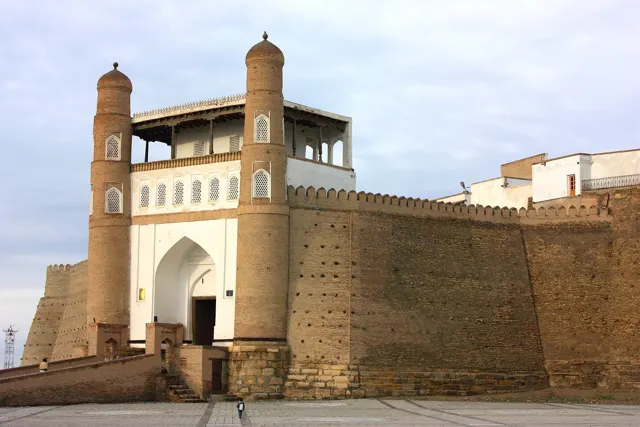 Ark of BukharaRising nearly twenty metres above the plain in the north-west of Bukhara, the Ark is among the oldest parts of the city. Inside its walls you can combine museums, restored palace spaces and centuries of dynastic history in a single visit.
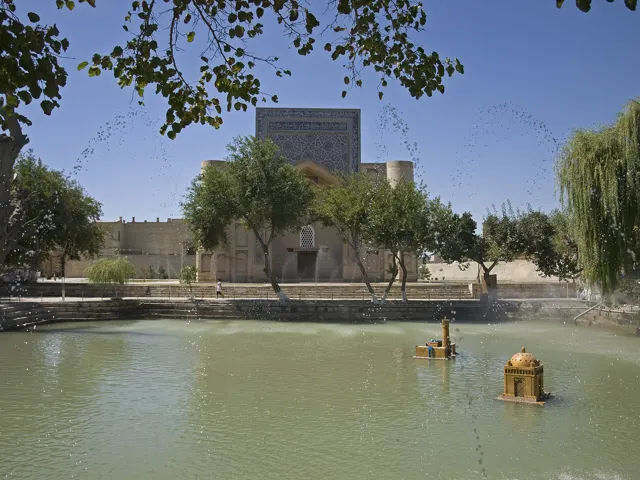 Lab-i HauzLab-i Hauz is a shaded pool in the heart of old Bukhara, framed by madrasas and a Sufi lodge from the 16th and 17th centuries. It is one of the best places in the city to sit with a cup of tea and watch daily life go by.
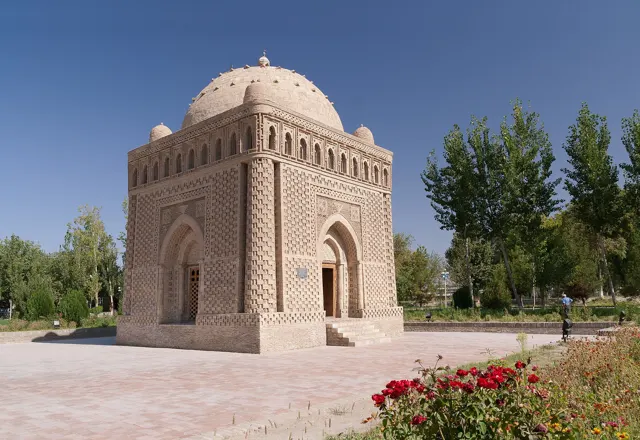 Samanid MausoleumStanding in a park just outside Bukhara's historic centre, the Samanid Mausoleum is one of the oldest funerary monuments in Central Asia. Small in size yet remarkably well proportioned, its brickwork rewards a slow look.
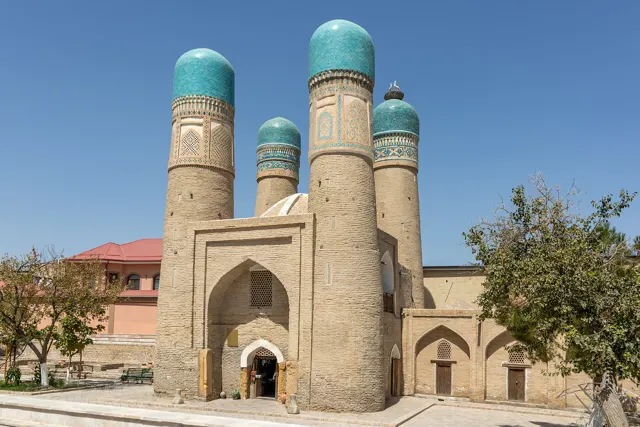 Chor MinorChor Minor is a small, unusual building in the lanes of Bukhara, topped by four blue-domed towers unlike anything else in the city. It sits just steps from the busy central squares, in the middle of everyday neighbourhood life.
Latest news
- Uzbekistan and World Bank discuss attracting investment
- Uzbekistan and IFC discuss transport and energy projects
- Uzbekistan to Create Full Cost Coverage System for Childhood Cancer Treatment
- Uzbekistan and EBRD discuss privatization and support for business
- Uzbekistan and Malaysia agree to train semiconductor workforce
- Mirziyoyev Discusses New Power Plants and Fuel Supplies With Foreign Investors